
Claiborne County Arrest Records and Court Charges
An arrest record is the account of the arrest itself. It shows who was taken into custody, the arresting agency, the date, and the booking entry made at the jail. In Claiborne County the sheriff is the county jailor and keeps the jail docket. After booking, a person is brought before Justice Court for an initial appearance, and bond may be set. None of that is the same as a conviction. An arrest only means a charge was alleged. It is the start of a process, not the end of one.
The court charge record begins when a prosecutor decides what to file. The county prosecutor handles lower matters, and the District Attorney handles felonies in Circuit Court. They file a charging document with the clerk, and from that point the charges are tracked through the case. The booking and custody side sits with the sheriff, so the jail roster and booking detail belong on the Claiborne County inmate records page. The full case file, plea, and outcome sit with the clerk, covered on the Claiborne County criminal court records page. This page follows the charges after arrest.
News coverage helps show how the local arrest-to-charge pathway works in practice. A June 2026 WAPT report on three arrests in a Claiborne County shooting case traced the early steps from arrest toward charges.
That kind of report names the arrest, but the formal charges are set and changed inside the court file, not the news story.
How to Find Claiborne County Arrest Records and Charges
There is no single free county search box for Claiborne County arrest records and charges. The statewide tool is PAMEC, the public side of Mississippi Electronic Courts. PAMEC carries the Circuit Court and Chancery Court cases where filed charges and charge status appear. Claiborne County sits in the 23rd Circuit District. Lower matters such as misdemeanors and DUI stay with the Justice Court, which has no online portal. The booking and custody side stays with the sheriff. So a full search uses more than one channel.
The sheriff keeps the jail docket but does not publish an online jail roster. For pretrial custody, a bond figure, or a court date, the direct line is the Claiborne County Sheriff at 601-437-5161. The official Claiborne County Sheriff page lists the office and its role.
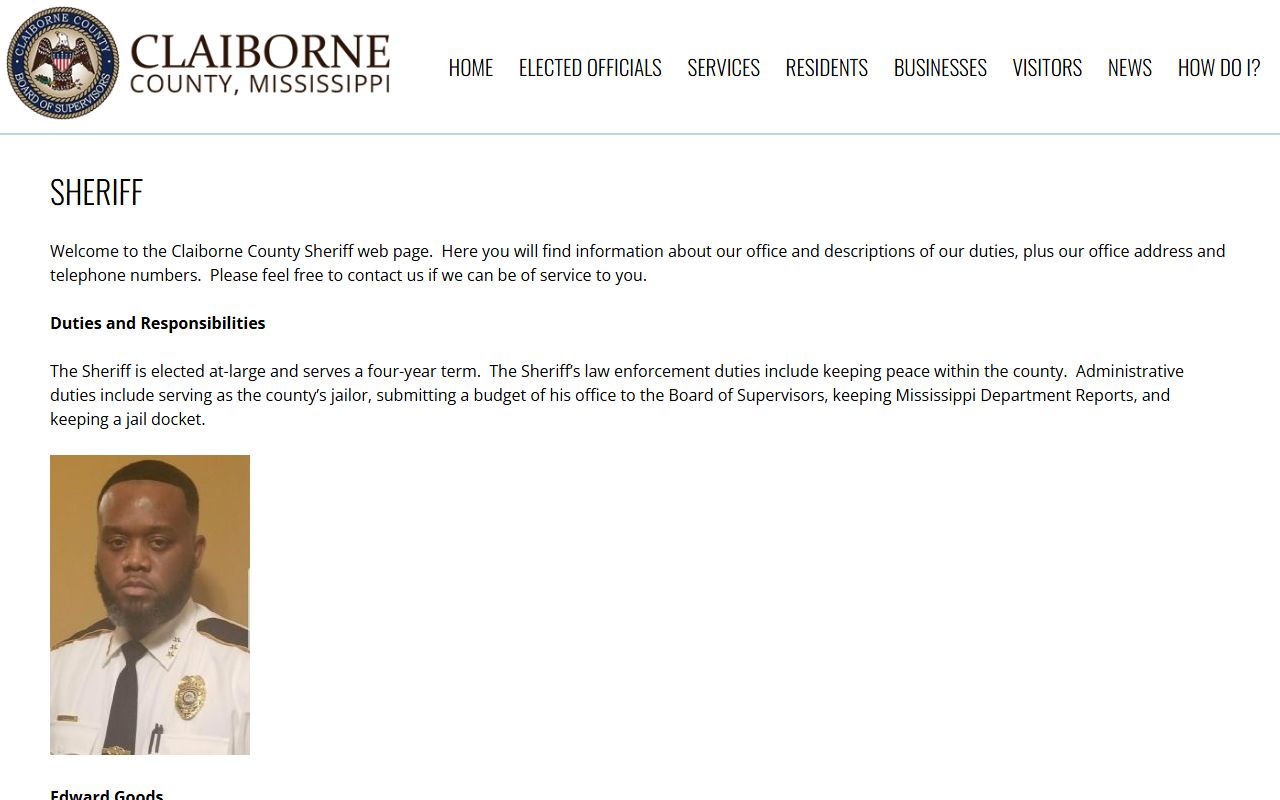
That page confirms the sheriff serves as jailor and keeps the jail docket, which is why booking questions go there by phone. Use the steps below to move from the arrest to the charges.
- For booking, bond, or custody status, call the sheriff at 601-437-5161, since no online roster exists.
- For a misdemeanor, DUI, or initial felony appearance, call the Justice Court at 601-437-4478.
- For a felony case in Circuit Court, search through PAMEC or call the Circuit Clerk at 601-437-5841.
- Open the case and read the charge list, then check each charge code, level, and status.
- For a certified copy of any filing, ask the clerk who holds the file. A printout is not certified.
Statewide criminal history is a separate lookup. The Mississippi Department of Corrections searches sentenced state inmates, and the state sex offender registry searches registrable convictions. Neither is a county arrest log, and both are addressed further down.
How Charges Get Filed After a Claiborne County Arrest
The charge record starts when a charging document is filed. In Claiborne County a felony case usually begins with a Justice Court affidavit and an initial appearance. The county holds court sessions at the jail three times each week, which secures an appearance within three days of arrest. After that, a felony can be bound over to Circuit Court and presented to a grand jury. The grand jury then decides whether to return an indictment. Lower charges stay in Justice Court and resolve there.
WLBT reported on a June 2026 Claiborne County case where a judge set bond at an initial appearance for arrest charges. The coverage of that initial appearance and bond decision shows the Justice Court step in action.
That early hearing is where charges first reach a judge, but the formal charging document is what fixes the count and the level. Three main types of charging document move a case forward.
| Complaint | Information | Indictment | |
|---|---|---|---|
| Filed By | Officer or prosecutor | Prosecutor | Grand jury |
| Common For | Misdemeanors | Many felonies | Serious felonies |
| Where in Claiborne | Justice Court | Circuit Court | Circuit Court |
| Starts | The case | The case | The case |
A complaint or affidavit can open a lower case fast. An information lets a prosecutor charge without waiting on a grand jury. An indictment is the grand jury's formal felony charge, common in Circuit Court matters.
Charge Status in Claiborne County Court Records
Charges are not fixed once they are filed. As a case moves, a charge can be amended, reduced, added, dropped, or dismissed. The court file tracks each change with a status entry. Mississippi Electronic Courts uses status flags on its case management pages, and the 23rd Circuit glossary lists terms such as Arraignment Pending, Plea Pending, Nolle Pros Pending, and CLOSED. Reading those terms tells you where a charge stands right now. The table below explains the common ones in plain words.
| Status | What It Means |
|---|---|
| Amended | The charge was changed, such as a new count or a corrected statute. |
| Reduced | The charge was lowered, often from a felony to a misdemeanor. |
| Dropped | The prosecutor chose not to pursue that charge. |
| Dismissed | The court ended the charge, sometimes with or without prejudice. |
| Nolle Prosequi | The prosecutor formally declined to proceed, docketed as nolle pros. |
A dropped or dismissed charge does not always vanish from the public file on its own. The arrest and the charge may still appear unless the record is expunged by court order. That step is covered later on this page.
Charge Codes and Severity Levels
Each charge is tied to a statute. The charging document names the code and the offense, so the file shows both the words and the legal cite. Mississippi sorts offenses by level. A felony is the most serious class and is handled in Circuit Court after the early steps. A misdemeanor is a lower offense, often kept in Justice Court or municipal court. Below those sit county ordinance violations and minor infractions.
One arrest can lead to several charges at once. A single booking may list more than one count, each with its own code, level, and status. That is why a charge list can be long even when one event led to the arrest. The level also drives where the case goes. Felonies route toward the grand jury and Circuit Court, while misdemeanors and ordinance matters stay in the lower court.
Note: A higher charge level can be reduced as the case moves, so the level shown at booking is not always the level a person is finally tried on.
Charges vs Convictions
Being charged is not the same as being convicted. A charge is an accusation. It means a prosecutor believes there is enough cause to bring the case. A conviction is the outcome, reached by a guilty plea or a verdict after trial. Many charges never become convictions. They get reduced, dropped, dismissed, or end in an acquittal. Reading a charge as if it were proof of guilt is a common and serious mistake.
| Charge | Conviction | |
|---|---|---|
| Stage | Accusation | Verdict or plea |
| Burden of Proof | Probable cause | Beyond a reasonable doubt |
| Decided By | Prosecutor or grand jury | Judge or jury |
| Public Record | Yes | Yes |
The full plea, verdict, and sentence are part of the case file, not the charge alone. For the complete outcome of a Claiborne County matter, the disposition is read from the criminal court record kept by the clerk.
Who Files Charges in Claiborne County
Two offices carry the state's charging power in Claiborne County. The County Prosecuting Attorney, Michael Keyton, represents the state in justice and county court matters, handles criminal appeals to Circuit Court, can present matters to the grand jury, and handles misdemeanor youth court work. His office line is 601-437-3322. The District Attorney, Daniella M. Shorter, prosecutes felonies in Circuit Court. That office presents cases to the grand jury, negotiates pleas, files dismissals or nolle prosequi entries, and recommends sentences.
The District Attorney serves the 23rd Circuit District from Hazlehurst. Sheriff and public-safety activity in the county often feeds the early stage of these cases. A June 2025 WLBT story on a Claiborne County sheriff public-safety matter shows the law-enforcement side that precedes a charging decision.
The sheriff makes arrests and runs the jail, but the choice to charge, reduce, or drop a count rests with the prosecutor and, for felonies, the grand jury and District Attorney.
Note: Indigent defendants should ask at the initial appearance or arraignment, or ask the Circuit Clerk, how appointed counsel is assigned, since the county had not published public defender details.
Statewide Charge and Criminal History Context
County charges can roll into statewide records once a case advances. The Mississippi Department of Corrections runs an inmate search for people in state custody, which is sentenced state inmates rather than the county jail. You can use the MDOC inmate search to look up a sentenced person by name or MDOC ID number. It is not an arrest log and it does not list everyone booked into the Claiborne County jail.
The Mississippi Department of Public Safety keeps a public sex offender registry. The Mississippi sex offender registry lets you search by name, by area, or by ZIP code after you accept its conditions. Registration follows a conviction for a registrable offense under Section 45-33-21 and following sections, not an arrest alone. The registry warns that a name and date of birth cannot give a positive match, since that takes fingerprints.
These statewide tools add criminal-history context to a charge, but they sit downstream from the county arrest and charge file. For the underlying case, the clerk and PAMEC remain the source.
Expunging Dismissed or Dropped Charges
A dropped or dismissed charge can often be cleared from public view. Mississippi expunction law, Miss. Code Ann. Section 99-19-71, lets certain arrests, dismissals, acquittals, and eligible outcomes be expunged by petition or court order. An expunged record is removed from ordinary public access. The statute reaches non-conviction outcomes such as a dismissal, a dropped charge, or a no-disposition matter, and it allows some conviction expunctions with limits. You can read the law on the Section 99-19-71 expunction page.
An expunction request is filed where the charge was handled. For a felony Circuit Court case, that means the Circuit Clerk. For a misdemeanor or Justice Court matter, start with the court that resolved the charge. The petitioner needs the case number, the charge, the arrest and disposition details, and the statutory basis. After an order is entered, the court, the arresting agency, the sheriff, and the prosecutor may each need a copy so their records stop disclosing the matter.
Expunged and sealed are not the same. A sealed record is closed from ordinary public access but still exists for limited official use. An expunged record is treated as if the charge never appeared on the public file. Both require a court order, and neither happens by itself.
Restricted Charge Records in Claiborne County
Some charge records are not open to the public. Youth Court records are confidential under Mississippi law, and access is limited to the court, the parties, agencies, and others the law allows. Sealed cases and expunged charges do not appear to ordinary public users on PAMEC. Active investigations may also be withheld until charges are filed. None of these gaps mean a record was wrong. They mean the law restricts who may see it.
Court filings also redact personal data. Mississippi Electronic Courts and Rule of Civil Procedure 5.1 limit Social Security numbers, dates of birth, minor names, financial account numbers, and home addresses. So a public charge record may show the offense and status while hiding the identifiers around it. When a record is missing or restricted, the fallback is the clerk who holds the file, or the sheriff for booking and custody questions. For a wider look at how all of these files connect, the Claiborne County court records page maps each court level to its custodian.
Important: This site is a private resource and is not a consumer reporting agency under the FCRA, so its data may not be used for employment, tenant, credit, or other FCRA-regulated screening.