
Criminal Court Records in Claiborne County
A criminal court record is the case file the clerk opens the moment the State files charges. It is not the arrest report and not the jail booking sheet. It is the court's own running file. Every motion, notice, order, and hearing lands in it. The file grows until the case closes. When the case ends, the record still shows what the charges were and how they were resolved. In Claiborne County, the felony case file lives with the Circuit Clerk, who is the clerk of the Circuit Court and the keeper of criminal litigation filings.
More than one court touches a criminal case here. Justice Court hears the first appearance after a felony arrest and takes the affidavit. The Circuit Court then handles the indictment, the plea, the trial, the disposition, and the sentence once a felony is bound over. Misdemeanors, traffic matters, and county ordinance cases often stay in Justice Court. The Circuit Court holds general criminal jurisdiction under Miss. Code § 9-7-81, which gives it original power over matters not assigned to another court. For the broader set of filings, see all Claiborne County court records.
How Claiborne County Criminal Cases Begin
A felony case does not open in Circuit Court. It opens lower and moves up. The local path is short but specific, and it shapes where the early record entries sit.
After a felony arrest, the defendant goes first to Justice Court for an initial appearance and the filing of an affidavit. The county notes that Justice Court judges hold sessions at the jail three times each week. That schedule exists to protect the right to a court appearance within three days of arrest. At that stage a judge can set bond and review the charge. If the felony moves forward, it is bound over toward the grand jury and Circuit Court. From the bind-over point on, the indictment, pleas, trial papers, and sentencing orders become Circuit Court and Circuit Clerk records.
The two prosecutors split the work. The County Prosecuting Attorney, Michael Keyton, represents the State in justice and county court matters and can present cases to the grand jury. The District Attorney, Daniella M. Shorter, of the 23rd Circuit District, prosecutes felonies in Circuit Court. A reader tracing a case follows it from the affidavit in Justice Court to the indictment and disposition in Circuit Court.
Stages of a Claiborne County Criminal Case
A criminal case moves through set stages, and each stage leaves a mark in the file. Reading the record means knowing which stage produced which entry. The flow below is the standard order for a felony that reaches Circuit Court.
Case flow: Charges Filed › Arraignment › Pretrial / Motions › Plea or Trial › Disposition › Sentencing
| Stage | What Happens |
|---|---|
| Charges Filed | The grand jury returns an indictment or the State files the charging paper. The Circuit Clerk opens the case file and assigns a number. |
| Arraignment | The court reads the charges and the defendant enters a plea. The record notes the plea and any bond conditions set. |
| Pretrial / Motions | Lawyers file motions, set hearings, and exchange evidence. Orders, notices, and continuances are docketed in order. |
| Plea or Trial | The defendant pleads or the case goes to a jury. Most Circuit Court cases here are heard by juries when they reach trial. |
| Disposition | The outcome is recorded: guilty, not guilty, dismissed, or nolle prosequi. This is the result line readers look for. |
| Sentencing | The judge imposes the sentence and signs the order. Probation, fines, and restitution are entered here. |
Note: a case can pause or restart, so the docket may show a continuance, a stay, or a bench warrant before it reaches a final disposition.
How to Search Claiborne County Criminal Court Records
There is no free county-built case search. Online viewing of Circuit Court case files runs through PAMEC, the public access layer of Mississippi Electronic Courts. Claiborne Circuit Court sits in the 23rd Circuit District, which went live on the system on October 28, 2019. The clerk counter is the no-cost fallback for older or restricted files.
- Confirm the court level. Felony case files are Circuit Court records held by the Circuit Clerk; lower charges may sit in Justice Court.
- Open the 23rd Circuit PAMEC system and register or log in. Public viewing needs a PAMEC account, not filing access.
- Search by defendant name or case number once inside, then narrow by case type and date.
- Open the case to read the docket, the motions, and the disposition or sentence.
- Request a certified copy from the Circuit Clerk if the record is needed for any legal use.
PAMEC charges an annual fee of $10.00 and $0.20 per page for documents. The login screen asks for a few fixed fields before the case-search tools appear.
| Field Label | Type | Required | Notes |
|---|---|---|---|
| Authentication Login | text | Yes | MEC filer or PAMEC username; public viewers use PAMEC. |
| Password | password | Yes | Account password. |
| Client Code | text | Varies | Shown on the login screen; a client or accounting field. |
| Forgot Password | link | Optional | Account recovery. |
| Register Online | link | Conditional | Needed if the user has no PAMEC login. |
The post-login case-search screen is gated, so its exact field names are not published. A counter visit or a mailed request to the clerk reaches files that are not online.
What a Claiborne County Criminal Court Record Shows
A criminal case file is built from many small fields. Each one answers a different question about the case. The table below walks the core fields a reader meets in a Circuit Court criminal file.
| Field | What It Shows |
|---|---|
| Case Number | The unique number the Circuit Clerk assigns when the file opens. It ties every later entry to the case. |
| Defendant | The accused person, listed as the party the State has charged. |
| Charges | The offense or offenses as filed, with the charge wording and any later amendment. |
| Plea | The defendant's formal answer to each charge: guilty, not guilty, or no contest. |
| Disposition | The outcome of each charge, such as conviction, acquittal, dismissal, or nolle prosequi. |
| Sentence | The penalty imposed after a conviction, including jail or prison time, probation, fines, and restitution. |
The file also carries docket entries, judge details, hearing notes, and financial lines for costs and bonds. Sensitive data is held back. Court privacy rules keep Social Security numbers, birth dates, minor names, account numbers, and home addresses out of public filings except as allowed. Recent county arrests show how fast these files open. A regional report relayed through the National Insurance Crime Bureau on a Claiborne County organized theft operation noted five arrests tied to one case.
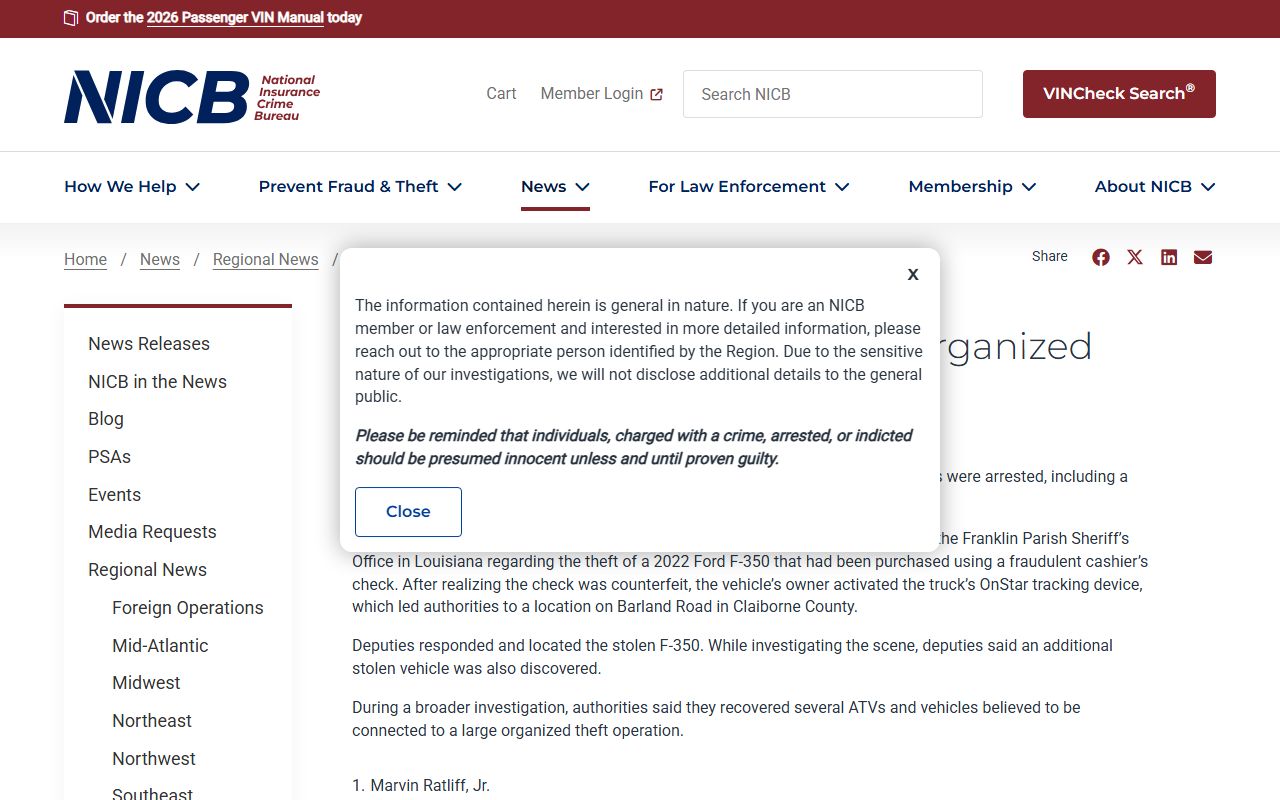
Each of those arrests can spawn its own court file, and each file then fills with the same fields shown above as the case moves through the system. To look closer at the charges themselves before a case develops, see Claiborne County arrest records and court charges.
Charges vs. Convictions in Claiborne County
Being charged is not the same as being convicted. A charge is an accusation. A conviction is a result. A Claiborne County criminal court record can list charges that were later dropped, dismissed, or that ended in an acquittal. Reading the disposition line, not the charge line, is the only way to know how a case ended.
| Charge | Conviction | |
|---|---|---|
| Stage | Accusation | Verdict or plea |
| Burden of Proof | Probable cause | Beyond reasonable doubt |
| Who Acts | Prosecutor | Judge or jury |
| Public Record | Yes | Yes |
A prosecutor may also enter a nolle prosequi, which ends a charge without a conviction. The docket will say so plainly. Treating an open charge as proof of guilt is a common and costly mistake.
Reading Dispositions and Sentences
The disposition is the heart of a criminal court record. It tells you the result. Common entries include guilty, not guilty, dismissed, no contest, and nolle prosequi. A guilty finding leads to a sentence; an acquittal or dismissal closes the charge without one.
Mississippi Electronic Courts uses short status flags that help read a case at a glance. On the Circuit side these include Arraignment Pending, BOUND OVER, Plea Pending, Trial Pending, Nolle Pros Pending, Pretrial Interv Pending, Probation, Probation Viol Pend, CLOSED, and Capias Pending. A flag of Trial Pending means the case is still open. CLOSED means the case has reached an end. Probation Viol Pend signals a possible breach of supervision after sentencing.
A sentence line breaks into parts. It may set prison or jail time, then suspend part of it, then add probation, fines, court costs, and restitution. Diversion can also appear: a Pretrial Intervention Pending flag shows the defendant may be in a program that can resolve the charge without a standard conviction. Read the full order, since the headline term is rarely the whole story.
Sealed vs. Expunged Criminal Records
Some criminal records are pulled from public view. Two terms describe how. A sealed record still exists but is hidden from ordinary public access. An expunged record is treated as if it never happened. Mississippi Electronic Courts uses both a SEALED flag and an EXPUNGED flag for these cases, and public PAMEC users should not expect to open them.
| Sealed | Expunged | |
|---|---|---|
| Visibility | Hidden from public | Destroyed / treated as never existed |
| Law Enforcement | Limited access | Very limited |
| Eligibility | By court order; youth court files are confidential under § 43-21-251 | Eligible arrests, dismissals, acquittals, and certain convictions under § 99-19-71 |
Expunction in Claiborne County is filed in the court that handled the charge. For a felony, that means the Circuit Clerk and Circuit Court. The petition needs the case number, the charge, and the statutory basis under Miss. Code § 99-19-71. Youth court records stay confidential by law under Miss. Code § 43-21-251, separate from any adult expunction.
Public Access to Claiborne County Criminal Court Records
Criminal court files are open records in Mississippi unless a law or order closes them. That principle drives the whole search. Start with the office that actually holds the file, then use PAMEC if the case is online. Certified copies always come from the clerk, never from a screenshot or a printout.
Key Statutes:
Mississippi Code § 25-61-1 - the Public Records Act keeps public records open for inspection unless another law says otherwise.
Mississippi Code § 9-7-81 - the Circuit Court holds original jurisdiction over criminal matters not assigned to another court.
Note: PAMEC viewing carries fees, but inspecting files at the clerk's public counter during office hours avoids the per-page online charge.
Background Check Considerations
A casual record lookup and a formal background check are not the same thing. A regulated background check follows the Fair Credit Reporting Act and is used for hiring, housing, or credit. A single court file viewed for personal reasons does not carry that legal weight, and a Circuit Court file may not reflect charges resolved in another court or state.
Important: This site is not a consumer reporting agency under the FCRA, and its information may not be used for employment, housing, credit, or other regulated screening.
Restricted Criminal Court Records in Claiborne County
Not every criminal record is open. Youth court files are confidential by statute. Sealed and expunged cases are closed to the public. Some documents inside an open case stay restricted to the attorneys of record or the court, and a PAMEC user may see an error when trying to open them.
Personal identifiers are also held back across all filings. Court privacy rules limit Social Security numbers, taxpayer IDs, birth dates, minor names, financial account numbers, and home addresses. When a file is sealed, restricted, or simply not online, the next step is the Circuit Clerk. The clerk can confirm what is public, explain the request process, and produce a certified copy where the law allows.